
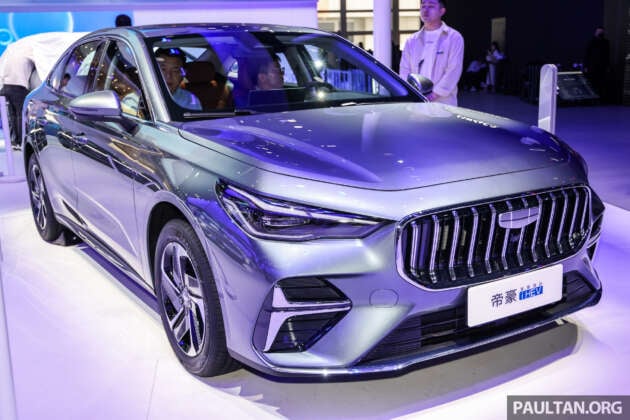


Aside from the Galaxy Starshine 6, Geely also showcased the related Emgrand i-HEV at the recent Auto China show in Beijing. Unlike the larger Preface and Xingyue L i-HEV, this segment-straddling hybrid sedan has yet to go on sale in China, but this particular model could be of significant importance to us Malaysians.
Firstly, the fifth-generation Emgrand is the successor to the car that spawned the Proton S70, meaning that it could very well serve as the basis for a replacement. That would bring with it economies of scale, as it shares plenty with the aforementioned Starshine 6 – a car that has already been confirmed for right-hand-drive markets, and which Proton CEO Li Chunrong told us is a “potential model.”
The new Emgrand is big – measuring 4,815 mm long, 1,885 mm wide and 1,480 mm tall, it’s 177 mm longer, 65 mm wider and 20 mm taller than the previous model, while its 2,755 mm wheelbase is 105 mm longer. This bumps it up a whole size class, from being a “B-segment plus” model to being over 100 mm longer than even the Honda Civic.

However, it still uses torsion beam rear suspension, rather than the independent multilink setup that has become de rigueur for this size of car. I guess Proton won’t be batting away claims that its version isn’t a “real” C-segment sedan anytime soon.
On the outside, the new Emgrand’s design is considerably more upscale than before, thanks to the lankier proportions and a sleeker six-window glasshouse. Details include slim and sharp headlights that flank a large rectangular grille with vertical slats (no Mercedes-AMG-style trapezoidal grille here, unlike the Starshine 6), plus a Volvo-style X-shaped air intake design.
Along the side a horizontal shoulder line links the head- and taillights, the latter featuring layered graphics and joined together by a black bar with the Geely script; there’s no full-width light bar, again unlike the Starshine 6. Also different are the two (unfortunately fake) rectangular tailpipes.

Inside, the new Emgrand continues to share plenty with the Starshine 6, including a dashboard with pill-shaped air vents and a wide centre console with dual smartphone holders and a 50-watt Qi wireless charger. There’s also the same 10.2-inch digital instrument display and a 14.6-inch infotainment touchscreen running on the latest Flyme Auto operating system.
There are a few changes, however, including a three-spoke flat-bottomed steering wheel to replace the Galaxy line’s two-spoke oblong unit (the one shared with the Proton eMas 7) and a centre console-mounted crystalline gear selector. This has also necessitated the repositioning of the dual cupholders fore and aft, as well as the ditching of the multifunction control knob for – joy of joys! – a row of physical switches underneath the touchscreen that control the single-zone air conditioning.
The regular Emgrand is powered by a choice of two engines, both already offered in Proton models. There’s the Saga‘s 120 PS/150 Nm BHE15-CFN 1.5 litre naturally-aspirated four-cylinder (here mated to a CVT with a simulated eight-speed mode), as well as the 181 PS/290 Nm BHE15-EFZ turbo version and seven-speed dual-clutch transmission that were only recently added to the S70.

With rumours rife that the S70 will gain the NA engine as an indirect replacement for the soon-to-be-discontinued Persona, there’s a distinct possibility that the fifth-gen Emgrand could come here in turbo-only form as a higher-end model (maybe as the S80?), while the current S70 soldiers on as an NA sedan to continue amortising its development costs. This is the case in China, where the fourth- and fifth-gen Emgrands are being sold concurrently.
The car you see here is a hybrid that may also be of relevance for Malaysia. The i-HEV powertrain essentially takes the EM-i plug-in hybrid system from the Proton eMas 7 PHEV – with its electric motor built into the 11-in-1 single-speed dedicated hybrid transmission (DHT) – then takes out the big battery and fits a much smaller pack instead, turning it into a self-charging hybrid.
Details of the specific powertrain in the Emgrand have not been released just yet, but it will most likely utilise the Starshine 6’s DHT, with a detuned electric motor making 163 PS (120 kW) and 210 Nm of torque. This should be paired with a version of the 1.5 litre NA engine, which in the Preface i-HEV churns out 111 PS (82 kW) and 136 Nm and delivers a record thermal efficiency of 48.41%.

As the eMas 7 PHEV has shown, however, this DHT can easily be paired with the less advanced 99 PS/125 Nm version of the engine, which has a thermal efficiency of just 46.5%. With Proton set to build not just the engine but also the hybrid components in Tanjong Malim, it will have all the bits (barring the battery, which would have been imported anyway) to piece together an i-HEV system on its own.
A DHT with a 120 kW output – where have we seen this before? Ah yes, a slide from Proton’s own presentation late last year, in which it earmarked a “DHT120” for an unnamed SUV. This car is widely tipped to be the AMA02, the forthcoming second model built on the Advanced Modular Architecture (AMA) after the Saga, set to be launched in the fourth quarter of this year.
Rumoured to use the name Saga Cross, the AMA02 is expected to take the form of an A-segment SUV, competing with the likes of the Perodua Ativa and Honda WR-V. The addition of the i-HEV powertrain would also enable it to steal sales from the Chery Tiggo Cross Hybrid, as well as snatching the title of Malaysia’s cheapest hybrid car. Besides the AMA02, the powertrain is also slated to appear on an AMA MPV further down the line. Excited? Let us know in the comments.


GALLERY: Geely i-HEV powertrain at Auto China 2026


The post Geely Emgrand i-HEV in China – possible next Proton S70; DHT120 hybrid powertrain coming to AMA02? appeared first on Paul Tan’s Automotive News.
